Conchas, Curiosity & Practice > Output
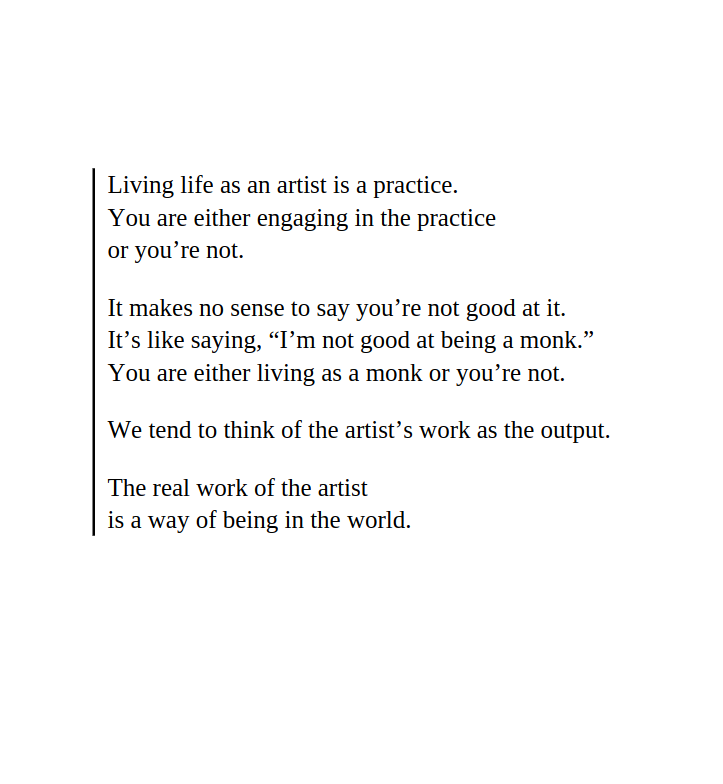
This is yet another Rick Rubin quote that resonated with me.
The way we interact with the world is genuinely all we have as storytellers. It is how we learn to tell stories, how we remain open enough to receive them, and how we collaborate without becoming rigid about what something is supposed to be.
Transparently, I’ve been on the defensive for a couple of years now when it comes to this industry. Responsibilities snowball. You become more familiar with the pangs of being ignored and rejected. Eventually, an anxiety begins to build beneath all of it:
Will this always be the case?
Will I ever be able to gather the people and resources necessary to truly be a part of something that reflects what I know I’m capable of?
I’m currently seeking a new talent agent. I had been with my previous agency since 2019, but companies evolve, as they do, and many of the people who originally served as advocates for my career are no longer there. It felt like the right time for me to change as well.
The strange part is that the past few months have made me feel, in some ways, like I’ve been transported back seven years. All of the experience, training, relationships, and knowledge I’ve gained have somehow landed me in a familiar position: attempting to communicate my value and my love for this craft to people sifting through thousands of others trying to do the exact same thing.
And just like in 2019, the stress begins to compound because each day you start conjuring up all of the opportunities you are supposedly “missing out” on.
With very little feedback, and most of the time no response at all, you begin blindly adjusting.
Maybe I need a different headshot.
Maybe my clips are not strong enough. Maybe they like a singular reel instead.
Maybe this email is too long.
Maybe I’m talking about the wrong credits.
Maybe I’m presenting myself incorrectly.
You keep tweaking the materials and changing the angle, hoping not to accidentally move further away from whatever invisible thing people are looking for.
And underneath all of that is the obsession with output.
Something needs to be happening. Something needs to be moving. There needs to be evidence that the work is working.
But the idea that you are only “doing the work” when everything appears to be moving perfectly forward feels increasingly antiquated to me.
We all know good stories are rarely told because everything goes right.
Why would our lives as artists be any different? Output is inconsistent. There may be months in which you are working deeply without anyone else being able to see it. There may also be incredibly productive-looking periods that feel creatively vacant.
Your practice is something different. Your practice is yours to discover.
Which brings me to bread.
Last month, I went to Mexico City and took a Mexican bread baking class. We spent three hours learning some of the history, working through the recipe, and eventually baking conchas, one of Mexico’s traditional sweet breads.
There were only four of us, including the instructor, so over the course of those three hours we got to know one another pretty well.
Our instructor shared that music was his first passion and that baking was something he had discovered and fallen in love with more recently. In fact, he had taken the exact class he was now teaching.
What stayed with him was not just the bread. It was the connection.
He loved how quickly a handful of strangers could become curious about one another simply because they were sharing an experience. He talked about embracing a somewhat nomadic lifestyle and allowing his art, curiosity, and spirit to guide him toward whatever came next.
At one point he said something along the lines of:
“There aren’t many of us, and the energy feels comfortable, so I’m curious…”
Then he asked us to share our names, what we loved most about life, and what we loved most about ourselves.
What do I love most about life? What do I love most about myself?
Two incredibly simple questions that, somehow, I had never really been asked to consider.
The first answer bubbled up almost immediately.It was part of the reason I had gone to Mexico City in the first place.
I love what we have to offer one another culturally.
I love learning, tasting, hearing, seeing, and experiencing the abstract ideas and feelings of other people aikidoed into a play, a dish, a building, a song, an article of clothing.
I love that we all seem to come from the same tree trunk and yet the branches can grow in such radically different directions.
There is always another way of doing something. Another way of seeing something. Another way of expressing what it means to be alive. That experience of newness is never-ending.
And piecing all of this together, I think that may be the foundation of my practice:
Curiosity.
As trite as that word can sometimes sound, curiosity informs my work and my practice more than anything I have actually made.
It is what keeps me watching. Listening. Traveling. Reading. Training. Asking questions. Changing my mind.
It reminds me that the practice does not disappear simply because the output slows down.
Perhaps the output is only the visible result of a much quieter practice: paying attention, remaining curious, developing our taste, and participating fully in the world around us.
That said, living as an artist does not mean constantly mining your life for content.
Every trip, friendship, conversation, or strange interaction does not need to justify itself by eventually becoming something you can show people.
Sometimes the practice is simply being present enough to experience something without immediately asking what it can produce. Maybe the question is not always:
What am I making right now?
The output is evidence of the practice.
It is not the entirety of it.
So I’ll leave you with the questions that were handed to me over a table of conchas in Mexico City:
What do you love most about life?
And what do you love most about yourself?